
Valorant and League both block ranked parties whose ranks sit too far apart, but neither blocks you from playing together. In Valorant, a full five-stack can be any ranks, and Unrated has no skill limit. In League, Flex has no rank limit at Diamond and below, and normals and ARAM are open to everyone. If one of you is far ahead, play those modes together, and the stronger player picks the job that sets up the other.
One player wrote in September that solo comp in Bronze is scary and their friends are too high rank to play with. The fix is picking the right queue for the night.
What you can queue together tonight
| Party | Valorant | League of Legends |
|---|---|---|
| Two or three ranked | Must fit Riot's rank table | Solo/Duo: two only, must fit Riot's table. Flex: no limit at Diamond and below |
| Four | Not allowed in Competitive | Not allowed in Flex |
| Five ranked | Any ranks, with an RR cut | Flex: no limit at Diamond and below |
| Unranked | Unrated: no skill limit | Normals and ARAM |
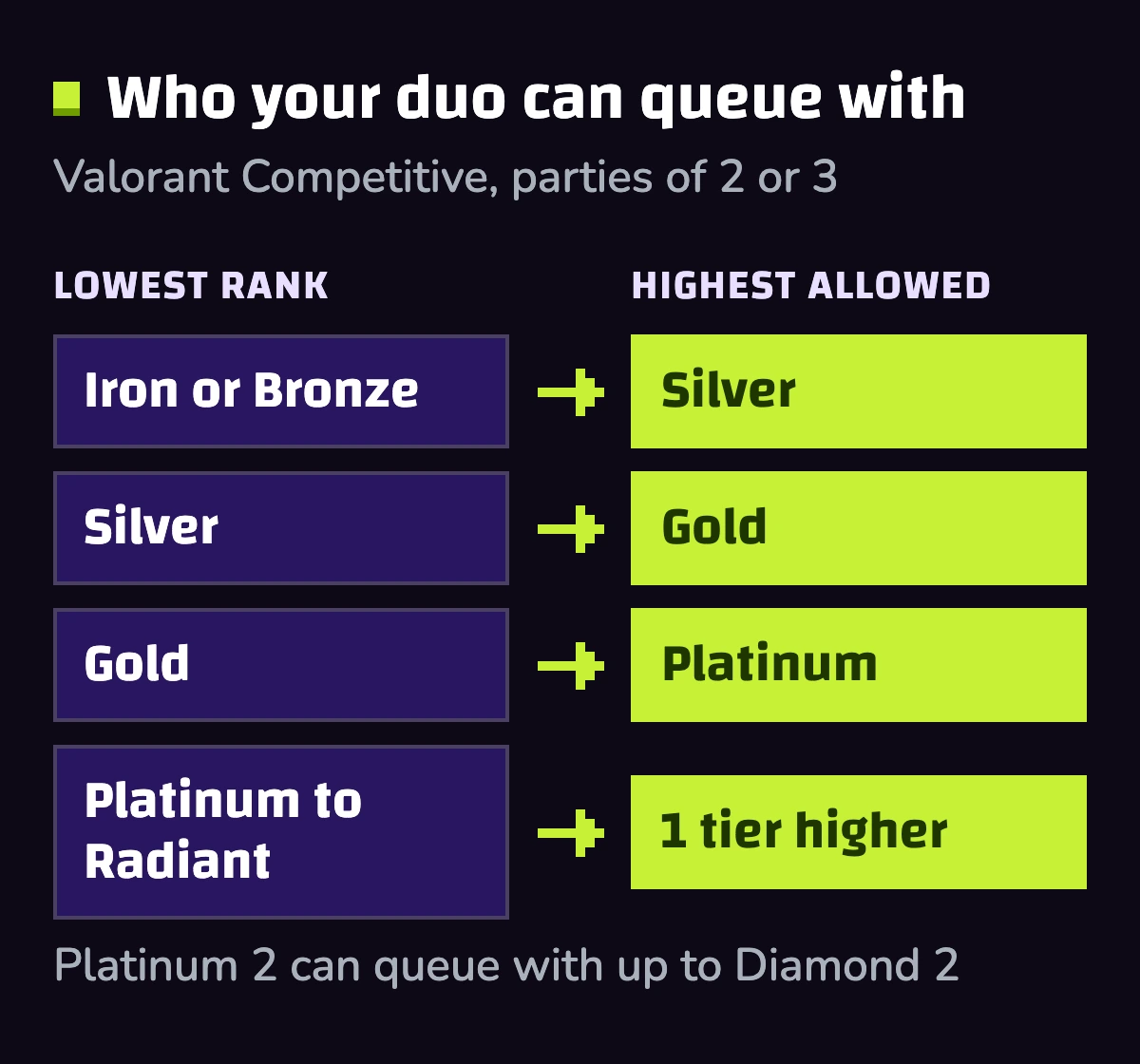
Valorant's limits for a party of two or three are in Riot's Competitive Mode FAQ, and from Immortal 1 you can only queue solo, duo or as a five-stack.
League's Solo/Duo table, from Riot's ranked queues page, goes rank by rank. A Gold player can duo with Silver to Platinum. A Platinum player can duo with Gold to Emerald. Emerald goes up to Diamond III. Grandmaster and Challenger can't duo at all. Flex is the open one: "there are no Flex rank restrictions for Diamond and below," with groups of 1, 2, 3 or 5. To play Flex with Master players and up, you have to be at least Emerald.
Riot's last word on Valorant Unrated is old: in 2020, Ask VALORANT #1 said "in Unrated, there's no limitation on who you can party up with skill-wise." For League, Riot doesn't list rank limits for normals or ARAM, and its enforcement FAQ points friends of different levels there.
What a five-stack costs in Valorant
A full party of five gets past the rank table, and Riot charges for it in RR. If everyone is Ascendant 3 or below and anyone sits outside the normal range, the whole team gets 25% less RR. With an Immortal in the stack, it's 25% however close the ranks are. With a Radiant, 75%, and Riot's FAQ adds that a Radiant grouped with players below Radiant loses 90%. Five-stacks only meet other five-stacks, so queues run longer too.
For a group with one player far behind, we'd play Unrated over a ranked five-stack. Everyone pays the RR cut and everyone waits longer, all so one friend can play ranked games where they're the weakest player in the lobby. In League Flex, Riot warns that groups with big skill gaps may get tougher opponents, because matchmaking makes up for the gap.
A ranked partner at your own level
Some nights you want to play ranked for real, and your friends are three tiers away. Finding a second partner for those nights doesn't mean leaving your group. You play ranked with someone the table lets you queue with, and you keep Unrated, normals and ARAM for your friends.
For Valorant, Gankster Duos reads your rank from your Riot account and shows you players close to it, so anyone you match with can queue with you that night. For League, it doesn't read ranks: in Social mode you match on the games you play, and you can write your rank and role in your bio. If rank and role matter most, the Gankster League of Legends LFG filters players by both.
Make the mixed game fun for both of you
The stronger player carries the job of making it work. Your friend already knows they're behind. Topping the scoreboard while they go 3-14 shows them nothing, and they'll stop asking to play.
In Valorant, take the agent that sets your friend up. On Sova or Skye, you find enemies before they peek. On Omen or Brimstone, you smoke the angle they're about to cross. Your friend gets one plain job: Sage walls and heals, or Killjoy holds a site with her setup. Say it's attack on Bind and they ask where to go. "I'll dart B site, you swing Long when I call where they are" gives them a fight they can win.
In League, ARAM is the easiest place to start: random champions, one lane, fights from the first minute, and Riot's FAQ notes that "ARAM MMR is different from your Ranked MMR." In a normal game, play support for your friend's ADC. You share a lane for the whole laning phase and can talk through every trade. If you'd rather jungle, gank their lane first and often.
Coaching is where mixed games usually go wrong. One thing per game, said after it ends, works better than a running commentary.
Say this
"Next game, keep your crosshair at head height when you walk around a corner. You were aiming at the floor a lot."
Not this
"No, why did you peek? Rotate. ROTATE. Okay, just stay with me."
For the weaker player, ask for that one thing. "What should I work on?" makes the game a lesson you chose, and it's easier to hear than a correction mid-round.
Next game Next time you play together, the stronger player picks a support role and gives one tip, after the game.